
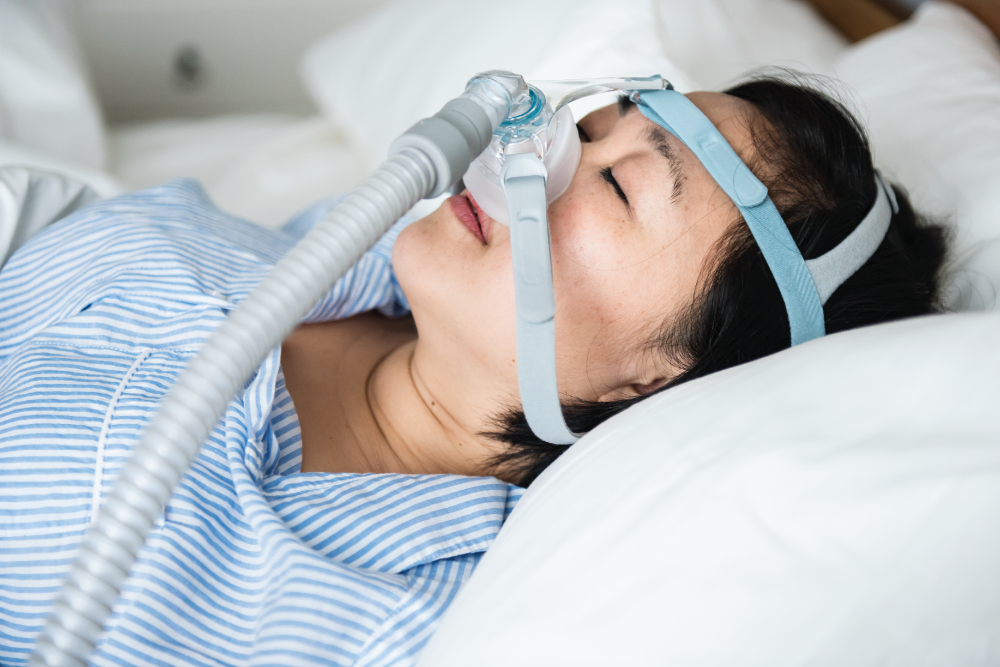
Fine-Tuning Your Treatment for Perfect Sleep.
An in-lab sleep study conducted after a patient has already been diagnosed with OSA (via Level 1 or Level 2 study). The sole purpose is to find the precise air pressure setting for a CPAP or BiPAP machine that eliminates breathing events throughout all sleep stages and body positions.
Key Features & What is Measured:
- All parameters of a Level-1 PSG (EEG, EOG, EMG, EKG, etc.) to monitor sleep architecture.
- CPAP/BiPAP Pressure Delivery: The technologist remotely adjusts the pressure throughout the night based on the patient's real-time response.
- Leak Management: Ensures the mask fit is optimal.
- Therapeutic Efficacy: Confirms that the chosen pressure eliminates apneas, hypopneas, and snoring, and normalizes oxygen levels.
Ideal Patient Profile:
- Any patient with a confirmed diagnosis of OSA who requires PAP therapy.
- Patients for whom auto-titrating CPAP (APAP) is not suitable (e.g., those with heart failure, central apneas, or on opioids).
- Patients who have failed to adapt to APAP therapy at home and require expert intervention.
Patients requiring advanced modes of ventilation like BiPAP or ASV.
Value Proposition for the Patient:
"CPAP is not one-size-fits-all. This study is like a custom fitting for your therapy. We work through the night to find the exact pressure that keeps your airway open, ensuring you get the maximum benefit from your treatment, leading to restful, restorative sleep."
Key Features & What is Measured (Typically 4-7 Channels):
- Airflow: Measures breathing through a nasal cannula.
- Respiratory Effort: Uses belts around the chest and abdomen.
- Oxygen Saturation (SpO2): Via a finger probe.
- Heart Rate/Pulse: Often derived from the oximeter.
Ideal Patient Profile:
- Adults with a high pre-test probability of uncomplicated OSA (e.g., high STOP-Bang score, loud snoring, witnessed apneas, obesity).
- Patients hesitant about an in-lab study due to cost, convenience, or anxiety.
- Follow-up for previously diagnosed OSA to assess therapy efficacy.
- Corporate wellness programs and younger, tech-savvy patients seeking a discreet option.
Exclusion Criteria (Mandatory):
- Suspected non-OSA sleep disorders (e.g., Narcolepsy, Insomnia, RBD).
- Significant cardiopulmonary disease, neuromuscular weakness, or congestive heart failure.
- Chronic opioid use.
Value Proposition for the Patient:
"Regain your energy from the comfort of your own bed. The HSAT is a convenient, cost-effective, and reliable way to determine if sleep apnea is the cause of your fatigue and snoring. It’s the smart first step for many."